

False Horizon
What if you found a lighthouse without a sea?

October 1948
The mountain vanishes, swallowed by the bend. Westley Arkwright takes his turns too sharply, as if curves are wrong for being this soft. Celeste Arkwright is undeterred by her older brother’s maneuvers. She has learned to read the angles of his mood in the stiffness of his character. The conversation doesn’t go where he wants it to. Still, she persists:
“The lighthouse marks a geographical revision. You’ve seen the topography, Wes. It’s geologically compressed, as if something vast was removed.”
Another bend. Another sharp angle. “Glaciers do this too.”
“Then tell me what you think it is—the lighthouse.”
Spectacled green eyes cut to her for a blink before the road ahead enraptures him further. “An old surveillance tower.”
“And the coastal features?”
“The only thing the builders knew how to architect. Then it was simply mis-contextualized by the locals as a seaside lighthouse.”
Celeste chuckles curtly. “Very convenient.”
“It’s a structure, Les. Made with bias, like all others. We’re here to study it, not idealize it.”
A thesis project, nothing more. The kind that means archives in the dead of night, town halls by morning, architect firms by noon. Some cartography, topology, and geological surveys. And drawings—Celeste’s favorite part—when the lines are still mysterious, the curves still hard to the mind.
It is her favorite thing: to stand at the threshold of understanding. To graze epiphany with her fingertips and taste its sugars on her tongue.
Westley, however, prefers the resolution, this downshifting moment when catharsis eases into afterglow. He prefers ash to fire.
Celeste will never understand it.
The road is hemmed in with woodlands. These dense pines that cluster too close together. Mist fingers through them, pressing against the rolled-up windows. Celeste spots a deer grazing in a ditch. And she sloshes her brother’s arguments, rolls them on her tongue for lapses in logic.
And she finds one.
“Riddle me this… why would a small village like Beacon’s Rest have a surveillance tower? It makes no sense.”
“Structures don’t survive their purpose,” Westley says simply.
“Only structures survive their purpose.”
He says nothing at that.
The change of scenery saves him the trouble.
The woods spit the Ford onto a dirt road. The flanks are wide with openness, and it contrasts sharply with the claustrophobia they just left.
In the distance, chimney smoke. Brown roofs pitched like tents in the hilly heath. Cobbled walls like sparse teeth circling the hamlet. Not a tree in sight, just… yellow grass blades combed by the breeze. That, and a declivity in terrain that steeples down—what the surveys heralded.
Celeste cranes her neck. The lighthouse is invisible from here.
Beacon’s Rest is a scatter of houses clotted downhill. There is no wooden sign at its fringe, no ‘established since’ proudly aging it. For the older places only need the veneer of their architecture to be placed in time. And this village is just shy of three centuries old, if one can only read the truth in its rain-washed bones.
The motorcar slows down as it enters the hamlet’s periphery. Around them, villagers hard at work, pulled from their labor by the gurgle of the engine. Westley uses the church’s steeple to orient himself. Their bed-and-breakfast lies close to it.
“Provincial,” Celeste sneers as they pass a modest edifice that she knows to be the town hall.
Westley slows down even more, then parks along the cemetery’s northern fence. They disembark.
And salt mists Celeste’s lips.
Westley circles the car to pick up their luggage from the trunk.
She gets closer to her brother. “Am I the only one smelling salt?”
He slings the leather duffle bag around his shoulder. “There is a salt mine in the area. Miles that way.” He gestures to the east. “Did you not read the geological surveys?”
She ignores the slight; instead, she crosses the street where their bed-and-breakfast awaits. A quaint, cladding’d house with flaking paint and dusted windows.
Westley knocks twice.
There is no sound coming from inside.
But then, a screech, and Celeste looks heavenward.
Seagulls drove overhead, screaming hunger with all their might.
Their host, Edith, is grey with age. She forgets their names, but not to collect every penny of what she’s owed. Westley pays. She lights up—all smiles and croons, and she sits the siblings down in the dining room, serves coffee and tea, then disappears into the kitchen, materializing too quickly with steamed fish and mashed potatoes.
Silence is precarious, especially with the grandfather clock that wheezes in agony from the adjacent living room, and their host’s hunger lies not in cod, but in gossip. “You’re here to study the lighthouse, aren’t you?”
Celeste smiles politely. “Yes, for our thesis.”
“Is there a lighthouse keeper?” Westley asks.
“Used to be. Died last summer.”
“How did he die?”
Celeste’s teeth clench, and she throws a sharp glance at her brother.
He doesn’t even look her way.
Edith’s lips flatten. “Was swallowed by the sea.”
“What sea?”
Celeste clears her throat. “Pardon my brother. The trip here was long. We should retire early to visit the lighthouse tomorrow morning, if you don’t mind.”
Edith’s gait, however, doesn’t mellow. It only squares. “Do not stay near the lighthouse when a storm is approaching.”
“What do you mean?” Celeste’s tone is gentle.
“I mean what I just said. The winds can get treacherous, the waters deep.”
Westley’s mouth opens, but Celeste kicks him in the shin.
“Understood,” she says with an amiable smile. “But last we looked at the forecasts, there wasn’t any storm coming.”
Edith’s small blue eyes taper. “The forecasts are always wrong. Beacon’s Rest doesn’t care much for them.”
The next day, the forecasts hold, for the siblings wake in a crude haze. They dress in a woolen coat and boots to tread the heath. Before Edith can wake, they are gone. Breakfast can wait. Their curiosity cannot.
Salt and seagulls scream overhead. Celeste closes the door, her fingertips lingering on a white ghost imprinted on the stone next to it—it is salt-stained, the white crystals falling like old grout under her nail.
Westley cites the geological survey and the old salt mine again.
But it is miles away. How can it haunt this far?
Celeste doesn’t insist.
They climb the Ford’s cabin and leave the village behind, making their way westward.
After a while, Celeste mentions Edith’s omens.
“Superstition,” Westley says. “A dime a dozen in remote villages.”
The pavement runs out, and they are surrendered to a trampled road.
“Agreed,” Celeste concedes. “But let’s keep an open mind. The villagers know the lighthouse better than our books ever will.”
Westley wants to retort, but he chooses otherwise.
And after a twenty-minute drive, they see it at last.
The beacon, blind yet proud, lording over a plain of dry heath.
The motorcar descends a lip of grass that flattens downward.
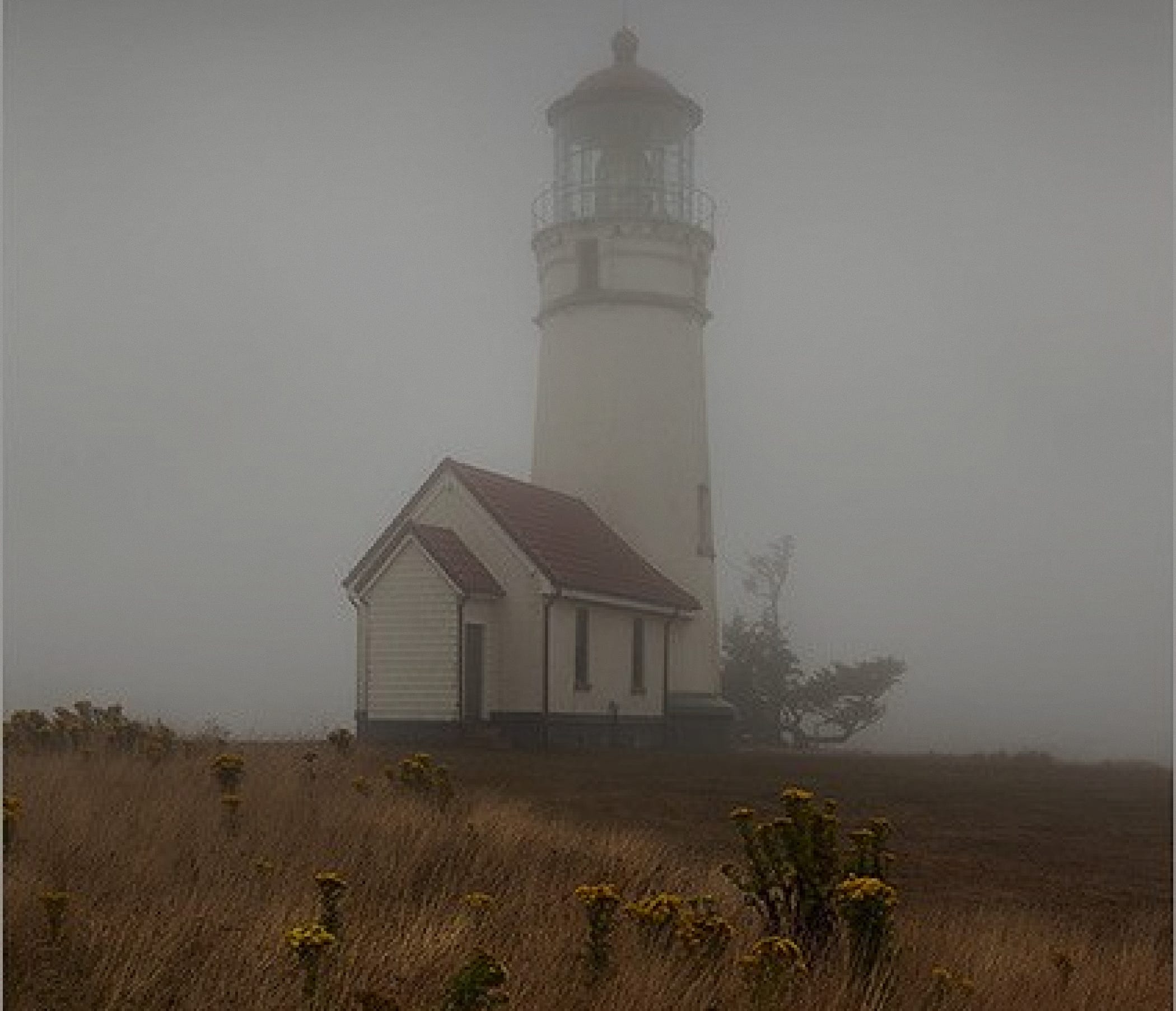
Ahead, the lighthouse stands ominously. Its paint is shell-white and a sun-washed red, and there is a small cottage attached to it—no doubt the lighthouse keeper’s home. The head of the landmark is circular, but its base is a perfect decagon—ten sides of clapboard that have seen better days.
Westley parks downhill. The Arkwrights disembark.
And Celeste’s legs wobble with vertigo. She catches herself on the car, steadies her gait. Westley asks if something’s the matter.
She shakes her head, the gauzy sensation pulling away from her throat.
And with this, they traipse down to the lighthouse, grass blades pricking at their calves, leather totes brushing against their hips.
The air is displaced once again, more brine than earth. But the seagulls are absent. Without them, all the siblings can hear is the breeze combing through the grass and the throb of an unhinged shutter tapping against the wooden wall of the keeper’s cabin.
They get closer. Here, salt and flaking paint mingle. The siding is weather-worn, rotted in places, betraying the lighthouse’s age. There is a rounded red door, curling into dereliction.
Instead of climbing the three stairs that lead to it, Westley tries his luck with the cottage door, but it is latched. So, with a shrug, he turns his attention to the landmark instead.
The lighthouse door gives way.
A watery darkness waits inside.
Westley steps in. Celeste follows.
They keep the door open to let in some daylight, but some of it already creeps through the slits between the planks. Dust motes drift sluggishly. The wood is streaked white.
Westley finds an oil lantern that he lights and hangs on a jutting nail. The dark coils back like paper to flame.
To their right, a spiral staircase, black metal and rusted. To their left, a desk with a handful of tin cans and another lantern, its glass shattered in places.
Westley lights this one too. His spectacles reflect it strangely.
“The walls are salt-stained,” Celeste remarks, pulling her sketchbook out of her tote. “Don’t tell me it’s the mine.”
Her brother shrugs. “I’m more interested in the architectural features. Like the decagon base. It’s quite a singular choice.”
“You said the builders erected it with bias, hence the coastal features. It seems they were a little craftier than you implied.”
His tongue clicks.
He only palms his notebook and his pencil, then immures himself in his mental measurements—all of which always come eerily close to reality.
Celeste moves to the staircase. It is metal and twist, charred-black, and she endeavors to climb to the lantern room. The stairs are pitched high—too high for comfort—and the railing flakes under her palm. Still, she ascends to the very top, counting the steps and coming short of one that should be there.
The room has shed its ten facades. The head of the lighthouse is a perfect circle riddled with curved windows. At its center, the beacon is a massive light bulb, its copper coils verdigris’d and cold with disuse.
From up here, the land reveals its inward shape. The lighthouse towers at the lip of its declivity. Could the geological compression be made by a glacier, like her brother suggested?
Celeste stays upstairs long enough to sketch the lantern room. And when she is done, she climbs back down, minding her steps.
Westley is hunched over the desk, jotting down his calculations.
“The staircase is missing a step,” Celeste says. “The lantern room is perfectly circular despite the decagon base.”
Her brother doesn’t even turn to her. “Human error.”
“I believe it intention.”
He whirls to face her then. “The construction is abnormal, I’ll give you that. But there’s no way to prove intention given the builders are long dead.”
“You’re wrong, Wes. The walls speak of their intentions.”
“You sound like Edith.”
She scoffs. “Perhaps the archives could prove me right.”
“Or wrong.”
“We need to visit, anyway. Get the blueprints to compare your measurements with.”
“I’m eager to see if we can find more about the cottage in the archives,” Westley says. “I’d like to visit that too.”
“Perhaps Edith knows something about it.”
“Perhaps. But I’d like to measure upstairs first.”
Another hour aches by before Westley relents pencil and paper to his tote and they make their way back to the car. By then, the afternoon has shed haze for clouds.
The strange vertigo grips Celeste once more, but vanishes as soon as they sit in the Ford’s cabin.
She asks her brother if he feels it too.
He doesn’t.
Credit: Pinterest
The sun here is sticky. A different brand than the one in Boston. It oils the stone walls like spray. It turns the sky bluish, but never ripens enough. Still, the day is new, its air fresh. The crisp has stolen most of the brine. But the seagulls still flock overhead, screaming their lungs raw.
Edith served breakfast. She asked about their trip to the lighthouse. Questions veiled in interest: “Was the keeper’s house latched still?”, “What did you think of it?”, “Did you find anything of interest?”, “It’s still magnificent, isn’t it?”, “Did the beacon light?”. Westley spoke as he always does: with his placidity, never answering a question directly.
But now the Arkwright siblings sit in the Ford’s leather, their host’s curiosity left on the porch, and they decide to take the long way to the town hall, just to chart more of the village.
The motorcar moves slowly. So Celeste can make the scant life eddying about. Here, a tavern, its vices exposed by the sun, relents a man with strange tattoos—an anchor, a pin-up sailor. There, another man sitting on his porch mending a fishing net. The sight is ectopic. An oddity that has no place in a landlocked hamlet. And then, they drive by a market where barrels of fish glut with ice melting in the daylight.
“This place is strange,” Celeste says as they park before the town hall.
“All villages are.”
The edifice is rain-washed stone, its interior wallpaper and wainscoting. They announce themselves at the front desk and are led to the basement where the archives are kept. The place is damp, the walls sweating cold. Not a place to store historical documents. Alas, they did not come here to lecture the villagers, so they carry on with their task. They pull maps, surveys, charts, and engineering plans from heavy drawers and settle on a wide table.
Westley is too meticulous for the conditions in which the archives are kept. He unfolds the maps, lets his palms smooth the creases while Celeste opens an almanac.
Silence falls once the wrinkles in the paper have been tamed. Save for the purr of the globes in their sconces.
Celeste reads through the entries, follows the tide of populations through its census, the weather patterns, the farming calendars. She discovers that there are more deaths in Beacon’s Rest than births, that the village bleeds slowly into abandonment. She closes the book, then pulls a nearby topography map. She tries to locate the salt mine, just to calculate the distance between it and the hamlet. But before she can find ammunition to disprove her brother, Westley’s tongue clicks.
“Odd,” he says. “Come and see.”
She rises, hovering close to her brother. They hunch over an old map of the city.
Westley’s finger glides along the lines and he points to an area labeled “harbor district”.
Celeste’s brow creases. “A harbor district without a harbor?”
“Western part of town.”
“We should take a look.”
Westley doesn’t protest. Instead, he jots down a few notes, then slides his notebook into his bag.
“And the lighthouse map?” Celeste asks him as the engine sputters alive.
“Engineering plans. Confirmed my calculations. But without architectural plans, it’s hard to infer builder intent regarding the coastal features. My theory still stands.”
They drive through narrow streets. The morning fogs against the rolled-up windows, condensation clinging to the glass.
Stone houses grow further apart as they make their way westward, replaced by worn wood. And where the buildings downtown were perched on hard foundations, the houses in this harbor district are high on stilts.
Westley pulls up, and the siblings stream out of the cabin.
Salt rushes to meet them. That, and the saline tang of rotten fish.
Celeste furls her palm against her nose. “This is foul.”
Her brother is unaffected, for he circles the car, then crosses the street. Erring closer to a stone post, he points to a thick metal ring.
A mooring ring.
“This makes no sense,” Celeste remarks as she draws nearer.
“My thoughts exactly.”
“So there was a harbor district. There had to have been a body of water here at some point in time.”
Westley scoffs. “You’re too open-minded. I think the villagers are delusional.”
“Why so?”
His hand cards through his hair. His locks are flat with dampness. “They probably believe there was a sea here. A generational mass hysteria is my theory. Like the dancing plague.”
“Wes, a man was mending a fishing net. There is a fish market. How did they manage to get fresh fish when they are far from the coast?”
His lip flattens. And he gestures around. “Well, show me the sea, Les.”
Celeste shakes her head. “There is no sea now. But there was one then. A salt lake, for certain. That would explain the geological compression near the lighthouse.”
“It explains nothing. If the lake were drained, it wouldn’t sweat salt to this day.”
“A combination of your salt mine and the lake.”
It is his turn to scoff. “You’re grasping at straws.”
“You likewise.”
Silence cotters between them.
Westley goes back to the car.
Celeste lingers behind for a moment.
She watches a seagull perch on the mooring bollard.
It starts screaming at her.
Its beady eyes hungry and piercing.
A ghost in the dark, that’s what the lighthouse is when basking in indigo. Vertigo still grips Celeste when they make their way along the declivity in the heath towards the landmark.
Westley holds a flashlight. She carries her bag.
They enter the tower, set the lanterns alight, then climb up the spiral staircase until they stand in the lighthouse’s head.
Westley’s flashlight flutters alight once more as he tries to locate the way to turn on the beacon.
Celeste draws a circle in the dust, gripping the bay window. Below, the grass is tranquil. Rocks, lonesome and pale, dot the heath here and there, an anomaly just as displaced as the lighthouse itself.
Fingers press against the cold glass.
And the light blinds her.
Celeste turns around. Westley stands before the beacon, head craned up.
The beam of light doesn’t oscillate. It doesn’t scan the land below.
It shines heavenward.
Getting closer, Celeste stands next to her brother. “Did you mess something up when you turned it on?”
“I didn’t turn it on.”
The light bleeds down the walls, having nowhere to escape. Its seething is oddly muted.
It doesn’t cover the rising sound of the surf.
“Do you hear that?” Celeste asks, looking around.
“Hear what?”
“It sounds like waves.”
She goes back to the window, faces the glare of the beacon, then endeavors to push it open.
The hinges are rusted. The paint flakes as the frame budges.
And the cold air of October rushes forth.
Along with the growing chant of the tide.
“Do you hear it now?” She asks her brother.
“I hear nothing,” he says, erring closer. “You’re tired.”
“I’m not tired; I hear the sea.”
“Then you’re delusional. Which one is it?”
Her lip stiffens. She moves across the room, circles around the lit beacon, then pushes another window open.
In time to see a drove of ghostly shapes loom downhill, spilling on each side of the Ford.
“Wes, come here.” The moment her brother berths next to her, she points in the distance to the moving shapes. “What’s that?”
A heartbeat. Perhaps two.
“People.”
The word swells between them, ominous, for their gait is strange, each body swaying as if bobbing on water.
The Arkwright siblings watch them approach the lighthouse. Villagers, all dressed in their nightclothes, gather at the foot of the landmark.
It is then that Westley makes for the spiral staircase. Celeste follows him down. The door is already open; they need only exit through it.
And when they spill out, they take in the odd sight of the villagers massing against each side of the decagon in clusters, palms pressed against the spoiled siding. The beacon throws a phantomatic light around, painting the limbs and the shifts milk-white.
They sway, as if they wade through water, palms against the clapboard like they hold the structure in place.
Most eyes are closed.
Are they sleepwalking?
The wind lilts, cutting at Celeste’s cheek.
The great expanse of grass shivers now, tidal pockets cresting through the heath.
And then, the lantern’s light falls away.
The wind dies.
The slumbered trance breaks.
Wordlessly, the villagers turn away from the edifice, ambling past the Arkwrights, heading back to the hamlet.
Edith singles out from the trickle of bodies, then walks up to them.
“Go to bed, you two. The storm is coming.”
Her voice is raw with sleep.
Celeste’s vertigo returning.
The place is quiet now.
There is no sign that a storm is gathering.
And yet, Celeste believes her.
Now she does.
The Ford beams ahead. The trampled road is lined with returning villagers. In the backseat, Edith is silent. Her thoughts are inscrutable.
“Do you always sleepwalk to the lighthouse?” Westley asks dryly. “It’s strange, wouldn’t you say?”
Celeste’s tongue clicks at her brother’s abrasiveness. She turns to the old woman. “Apologies for my brother. What he meant to ask is if this is a common occurrence.”
Edith faces her, her eyes flighty. “We’re not sleepwalking. We don’t go to the lighthouse when a storm brews. Never. We know better.”
Celeste’s smile is faint. The kind given when evidence points to the contrary. “But you are in our car, driving away from the lighthouse.”
Edith’s eyes taper. “Wasn’t I always?” And then her voice pitches louder. “We must make haste before the storm hits.”
It is obvious Edith will evade further prying, so they spend the rest of the drive in silence.
The bed-and-breakfast is a scattering of shadows. All of them reel back the moment Edith finds the interruptor. She goes to the shutters first, latching them all while the siblings set down their totes and shuffle to the living room.
The air smells of niter, of this crisp that rides the leeward before a storm. And soon enough, the wind swells again, pressing against the house’s flanks. The sheathing groans in its stone corset mere minutes before the rain frills the gutters.
Edith mutters something about making tea. Celeste settles on the davenport with her sketchbook while Westley endeavors to build a fire. Amber grows against the page when Celeste takes graphite to it, absent-mindedly drawing the lighthouse’s spiral staircase, trying to fit the missing step. For long minutes, Westley gazes into the flames, his mind no doubt busy with the same mystery.
Edith comes back with a tray. She places it on the coffee table.
Westley turns to her. “What is the lighthouse’s story? In your own words.”
Celeste doesn’t intervene this time. Her brother will persist. Instead, she draws a straight line through the spiral, then draws more of them.
Their host smiles faintly. “Do you want tea?”
“I would rather have enlightenment.”
“The tea is fresh. I bought it at the market two days ago. Try some.”
“I don’t want tea. But I’d like answers. If you may.”
Edith serves three cups of tea before sitting the armchair, saucer poised on her knee. She doesn’t answer Westley’s inquiry.
His lip stiffens. He asks no more questions .
Instead, he settles on the davenport, pulling his notebook onto his lap to read through his observations.
Outside, the storm tosses. Lightning crawls through the shutters.
The grandfather clock counts an hour.
And when it strikes ten, the Arkwrights decide to retire for the night.
They climb to the second floor, Celeste ahead of her brother, but before she could reach her room, Westley grips her arm. He gazes through the dormer window, then points in the distance.
A red light bobs in the dark. Recluse and ominous.
Celeste gets closer. The rain blurs the sight. But she can make the conical silhouette. “Is that… a buoy?”
“It cannot be. Surely a radio tower.”
“There is no radio tower in the area, Wes.”
“So you’re telling me there’s a buoy floating in the sky?”
Her eyes narrow around the strange shape.
But rain blears it further.
And when a white knife tears through the sky, the strange object bobs on the horizon no more.
The storm ate through the heath. It left bite marks in its wake. The grass, soft and dewy, squelches underfoot. But the Arkwrights are undeterred. Westley strides to the keeper’s cottage, a crowbar in tow. He chose to break into it the moment he woke, whispered his plan to his sister to avoid Edith’s prying ear.
Celeste had no protest on her tongue. She dreamed of a shingle beach, awoke with the press of salt on her lips.
Her brother makes quick work of the door. The lock gives, and he pushes the gate open.
The headiness of wet wood and the tang of abandon answer them. Daylight slashes through the slits in the siding. The place is scant with furniture—a cot pushed against the wall, a desk against the other, a dresser, and a wood stove. And trinkets. Various sundries that gather dust and cobwebs—seashells and bottled sand and even a lifebuoy, sun-eaten and faded.
Westley goes straight for the desk where papers lie. Celeste joins him over what appears to be an old map of the area. There, on paper, they find the year—1751—and a coastline running through a hamlet.
“It’s Beacon’s Rest,” Westley says, following concentric circles of the topography with his index. “This is the hillet we drove down when we arrived. And the harbor district is right there, like on the city map.”
“Then there was a sea here,” Celeste remarks in awe.
“There wasn’t any sea here, Les. The cartographer was clearly wrong. There is no geological evidence that there was any body of water close to the village.”
Celeste moves the map out of the way, revealing another one beneath it. This one has 1887 penned in the corner. And there, where the coastline was, a sea stands no more.
Westley’s brow creases.
And wordlessly, he opens the desk drawers, then pulls notebooks from their depths.
Logs. Within it, recorded shipwrecks with geographical coordinates that coincide with the lighthouse’s location.
“This makes no sense,” Celeste says. “A salt lake is one thing, but shipwrecks are another.”
Westley peels another book open. “The keeper’s diary, it seems.” His eyes dart on the page, and he reads: “June 16, 1946. Another one went down, swallowed by the waves. Its hull is split open as if it collided with a reef. I took the cottage’s shaft down to inspect the wreck. There were no bodies. Still, the dark shifted.”
“A shaft?”
Westley looks around. And there, half concealed by the cot, is a wooden hatch.
He moves the bed out of the way.
The crowbar does quick work of the rusted lock.
And when he turns to Celeste, she knows what he will say before the words fall: “Down we go.”
The ladder sighs under heel. Its wood is damp; each step treacherous. Westley is the first to go down, his flashlight in tow. Celeste doesn’t know what to expect. But she surely didn’t expect the softness of sand to meet her soles.
Westley stands a pace away from the ladder, his flashlight on the ground illuminating something.
The skeleton of a ship.
The thing beached starboard, its prow cleaving through the darkness. There are holes in the hull, saw-toothed, and curtains of dried seaweed clinging to their hem.
Hairs rise along Celeste’s forearms as she takes in the vast, fathomless expanse of sand spilling on each side.
Westley crouches to palm the flashlight, then trains it further away, catching the shape of a second shipwreck. And then another.
For watery seconds, the Arkwrights idle.
Until something shifts in the dark.
Celeste’s stomach dips. Something cold pressing against her breastbone.
Silence. No hiss in the sand.
And then, a groan, loud enough to ride the distance; the agony of a ship being torn asunder.
Another shift in the dark, and—
Panic.
Celeste turns heels, making for the ladder.
Westley follows close behind.
They climb fast; the wood protesting under their weight.
And when they both spill back into the cottage, Westley moves the cot over the hatch.
The air festers with more brine.
Celeste tastes it in her throat.
“Logic can’t explain that,” she says, her hands trembling. “There’s something down there, Wes. There was a sea.”
For once, he falls short of a theory. “Perhaps. I—I don’t know.”
“Then why did you run?”
Westley’s jaw is clenched.
He won’t say a thing.
So Celeste goes back to the keeper’s diary. She flips through the pages. And there, at the end, the last entry. Not words penned on the lines, but rather a drawing—
A spiral with a straight line going through it.
The same thing she drew as they hunkered down, waiting for the storm to roll away.
“Did you find something?” Westley asks.
She points to the drawing. “I drew the same thing.”
With this, she steers him toward the exit. The siblings spill into the crude daylight, moving uphill to the Ford.
Pulling her tote out of the cabin, Celeste peels open her sketchbook to the drawings. “I believe the straight line is the lantern’s beam. The spiral is the staircase. I’m sure we’ll find answers in the lantern room.”
“It’s just a coincidence.”
Heat clambers beneath her cheeks. “You must be joking! We just found a massive underground chamber with shipwrecks. You heard the noise. The lighthouse beacon behaves strangely; the maps show a sea. It’s no longer about architecture or logic, Wes. It’s about a shift in paradigm.”
He scoffs at that.
And in the face of her brother’s reticence, she adds: “I’m going back to the lighthouse, with or without you.”
“I’ll wait here by the car,” her brother says simply. “I’ll wait out your delusion.”
Teeth skitter along her inner cheek.
The sky curdled grey.
There will be another storm despite the forecast.
Still, she stalks toward the landmark.
And the lighthouse grows closer, like a caviling finger stretched to the heavens in reprobation.
Frightened. Her brother’s words reeked of fear, and the moment logic could no longer explain anything, he clambered behind his shell.
Celeste doesn’t look behind. Despite the vertigo, she makes it to the lighthouse, finds inside the same cobwebbed angles, the decagon’s wounded sheathing.
One by one, she ascends the stairs, making for the lantern room, her sketchbook in tow. She thumbs it open on the floor, her index finger following the coil of the spiral grooved into the paper. Then, she moves about the room, determined to chart it like an incomplete map.
There isn’t much to map. The walls are round; the windows frameless. So she inspects the beacon instead. Minutes fall by before she finds something of interest.
A furrow carved in the metal, right there at the base. Her fingertips follow it until she can make up a spiral.
She cranes her neck.
The same symbol is chiseled into the beacon’s foot.
She understands it then.
“What if the lighthouse isn’t marking the sea?” She whispers to herself. “What if it’s holding it back underground?”
There is a flicker. Like the thud of a moth tapping wildly against glass.
The beacon comes on.
The light bleeds down the walls.
It paints the place an ominous white.
Celeste grabs her sketchbook, then moves to the balustrade. She pries a window open.
The wind lashes at her cheek, an angry thing.
“Wes! I found something!” she yells, but its howl is too strong, her brother’s name pushed right back against her lips.
He still stands by the car, his spectacles awash in the beacon’s light.
In the distance, a swaying crowd.
The villagers.
Her brother still stares at her.
Until his neck bends down.
And there, at his feet, the ground is no longer trampled earth, but water—water that rises from the heath.
The grass blades shorten.
So do his brother’s legs as they are eaten by the ground.
“Wes!”
He sinks further—
Thighs, hips, waist, chest.
The villagers grow closer.
They shuffle around the car, illuminated faces like white porcelain masks.
Shoulders, neck.
She screams her brother’s name again.
On his lips, a single gasp—
Before he goes under, his spectacles disappearing along with him.
The villagers don’t come to his help.
They simply walk toward the lighthouse.
Celeste’s breath clots.
Her heart is mad with fear.
And she looks down at her drawing.
To the second straight line that strikes through the spiral.
The book meets the planks of the lantern room.
The beacon goes dark.
Underfoot, the lighthouse groans.
And a sea of grass crests to meet it.
Author Notes
Thank you for making it this far. I know this story is also on the longer end of the spectrum. I was inspired by a Pinterest image of a lighthouse in a field. And I felt like there was something creepy about it; something that also gave me Lovecraftian vibes. So here we are. I hope you enjoyed this one!
If you wish to follow my writing journey and enjoy reflections on the craft, creative burnout, and other curated aesthetics, you might enjoy my second publication, Sweet Anemoia. You can find it here:
© 2026 C.C. Harlow. All rights reserved. No part of this work may be reproduced or transmitted in any form without permission of the author.
Definitely different than anything I've read before!
Okay, my second coffee of the day is prepared, and I've served myself grapes. Let's dive in. (Writing this comment as I read!)
Aaaand I had to stop reading to write literally on the first paragraph. What I love about your writing is that it reveals so much with so little, like a perfect arrow that arrives at the mark. In the first paragraph, you just told us so much about brother and sister and family dynamics: he leads, and she reads his moods. He is sure; she is the one who questions.
"It is her favorite thing: to stand at the threshold of understanding. To graze epiphany with her fingertips and taste its sugars on her tongue." I already like and resonate with her (I am also the second daughter!). Themes that spring to mind: analyzing a historical artefact or piece of architecture without reverence. I am paying attention to Wes when he says that they are just there for info on his thesis, as if whatever they are about to see should serve them, not vice versa. The end result vs. the process, the end of the road vs. the journey, utilitarian thinking vs. curiosity thinking (maybe? We shall see.)
"Cobbled walls like sparse teeth circling the hamlet." Great line. I notice your writing uses "teeth" and "mouth" imagery as recurring symbols of dread or mystery. I love that as a stylistic mark.
"His spectacles reflect it strangely." I like how the prose lingers through his spectacles at various points, as if we are seeing things through his eyes, and it also adds mystery.
The sentiment that "all villages are strange" is amazing and true. All villages have their folk tales threaded through them, and this one is no different. I am afraid they will soon find out why the people here are so taken by the sea, even though it is landlocked...
I love the recurring smells of salt, brine, and rotten fish, and what they symbolize for the characters: that their environment makes no sense. Also, the seagulls that seem to scream "hunger" and have "hungry eyes". What are they hungering for, and why do they linger? Are they waiting for the sea to come back? I like that Celeste observes them.
Okay, rework of my theory: Wes symbolizes pure reason and logic, Celeste (appropriate name btw) symbolizes belief, a belief in the hidden world. I am noticing how Wes uses the word "delusional" to describe the villagers, while Celeste is more willing to understand their behavior (as she should, she is an outsider; what do they know?). Another theme I see is a bit of sibling rivalry, which is perfect for this story and this ambience. Who is right? We shall see...
(Another theme I love that is recurring in all your stories: strangers or outsiders coming into a new, foreign environment, and how they react to its dangers.)
Oof, the scene with the villagers was tense. What I am predicting: Wes will want to visit the lighthouse again, but Celeste will try to deter him from going, as she now believes in the storm.
I love how Edith's eyes "taper" to symbolize she's not "all there", not fully awake.
Celeste keeps seeing sea-related images, the buoy, the waves, etc., but I like how the story is never really confirms if it's all in her head or if it's real. At least not yet.
I like Wes and his willingness to investigate, even though I feel he is being stubborn. But I fear I might be him in this situation also. Now, I am thinking of him as the one who questions, not Celeste. I guess this happens a lot to people who want to be right about things and are stubborn about it; they go down the rabbit hole of "I need to know."
THERE IS A SEA UNDER THE ATTIC. OH THIS IS SO GOOD IT GAVE ME CHILLS!! The groan of the shipwrecks and the prose ("watery seconds") was excellent in this part. This story is making the sea something very frightful...which it is, actually. But I love the contrast of an ordinary setting (a landlocked hamlet) with what lies under the surface (a strong, almost vengeful sea!!!)
Okay, you caught me off guard. It is CELESTE the one who wants to go back to the lighthouse, not Wes. I MUST REMAIN CALM NOW. The story is picking up like the storm...
"Her brother’s words reeked of fear, and the moment logic could no longer explain anything, he clambered behind his shell." Exactly correct, and I am a firm believer that logic is not enough to explain the world we live in, as this story demonstrates...
NO!!! they were taken by the village! Okay, so is the second line across the spiral supposed to represent her? Are they a sacrifice to the sea? Let me go back and see if there was any foreshadowing.
Okay, Edith warned them about the sea swallowing people up by the lighthouse. It seems like the people there weren't looking to actively use the newcomers as sacrifices, but they know how the village works and are preparing to catch fish and use sea to their advantage, and just kind of reticent to newcomers not following their warnings? No? This is how I interpret it.
GREAT STORY AS ALWAYS!!! I loved reading it, and the theme on delusion vs. belief was amazing, embodied by siblings.
New words learned: ectopic, almanac, niter.